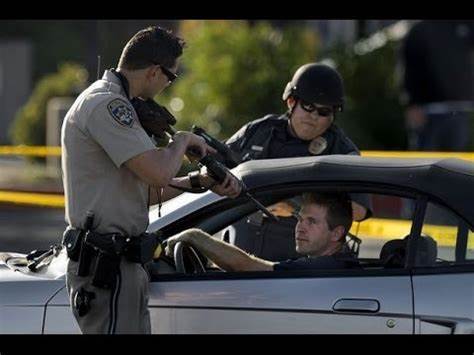
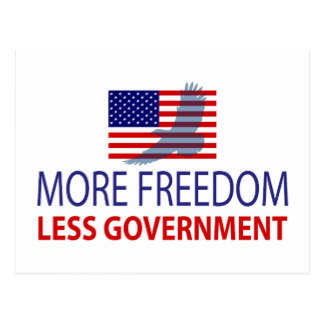
Americans are so enslaved now that Americans scream that anyone who loves freedom, peace, and balanced budgets is a traitor and must get out of the USA.
Americans cannot see hypocrisy.
Americans swear that Biden is an evil monster for embracing war, debt, and tyranny, but then Americans turn around and insist Trump is a holy god for supporting war, debt, and the police state.
Strange how Trump can quickly regulate airline seats and ban bump stocks, but is powerless to stop illegal immigrants, reduce refugees, end wars, end Obamacare, reduce the debt, or restore the Bill of Rights.
4d chess, right?
Americans are only interested in bread and circuses, celebrities, movies, sports, sex, drugs, or irrelevant issues like free college, homosexuality, and slavery reparations.
Americans say surrender is the answer to tyranny.
Americans are not interested in solutions to the collapse. Americans only want to blame, point fingers, and say that they're not at fault and not responsible for anything.
Why can't Americans unite and agree that debt, wars, and tyranny are bad?
Do you think things would change in the US if Americans protested? What if the Gestapo, government workers, politicians, and soldiers went to work and were not sure that they would come home? What if Americans attacked government buildings?
Some of the problems with tyranny is that remaining silent means that you accept debt, wars, curfews, gun bans, NSA wiretapping, checkpoints, forfeiture, the end to the right to silence, free speech bans, torture, kill lists, no fly lists, searches without warrants, private prisons, mandatory minimums, 3 strikes laws, DNA databases, CISPA, SOPA, NDAA, IMBRA, FBAR, FATCA, TSA groping, secret FISA courts, and Jade Helm.
Assange is in jail because of your silence.
The blood from US wars is on your hands.
Another problem with tyranny is that it grows.
Do Americans think that because straws are illegal now that the USA is a paradise? Do you think tyranny will not continue?
The US seems to be waiting for a spark like Yorktown today.
Will Americans revolt when the stock market crashes, property is nationalized, books are burned, guns are confiscated national ID card are required, passports are revoked, domestic travel permits are required, Americans are required to submit a DNA sample, give fingerprints, get microchip implants, and be registered in a facial scan database, Internet filters are required on all computers, mobile phones are banned, the Internet is shut down, free speech and protests are illegal, reporters are arrested, government loudspeakers are installed on street corners, newspapers, magazines, and TV and radio stations are closed, churches are shut, neighborhood watch groups are set up, undercover police are everywhere, warrantless home searches are routine, taxes are raised, cash is banned, there are negative interest rates, bank fees, bail-ins, capital controls, gold is outlawed, torture and extra-judicial assassinations are routine, government drones and robots patrol everywhere, lawyers are arrested, elections are canceled, juries are banned, courts have show trials, congress is eliminated, Americans are required to wear uniforms and attend study sessions, or concentration camps are opened and Americans are starved and killed?
What if Americans never rebel?
How do people live under tyranny?
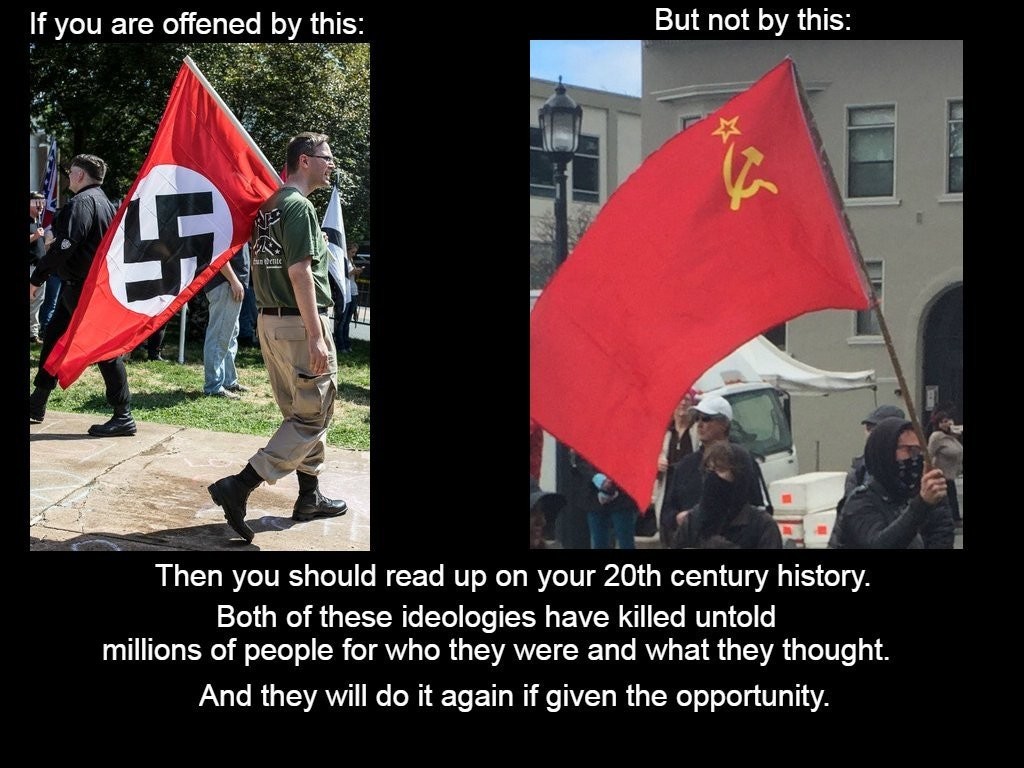
If you lived in China in 1947 would you join the Communists, fight Communists, or flee to Taiwan?
Would a Vietnam prison
guard in a re-education camp have ethics or try to justify his job?
How would feel if you spent your whole life in the USSR? Would you think that you are free? Would you think bread lines are normal?
How would feel if you lived in North Korea and were in a concentration camp because your dad found a Bible?
Cuba is a police state because they are cowards.
Are Americans pussies, too?
Can't freedom go viral?
Do you think tyranny is a joke? Do you see what is happening?
Libertarian
boosted
Does anyone get the feeling that the Uniparty has been bought off by the elites?
Libertarian
boosted

@dcjogger hate speech is a divisive trope created by leftists to define all speech they disagree with. It is important to point out how what is abhorhent speech to a majority is the example to punish the minority and the majority via self censorship.
Does anyone get the feeling that the Uniparty has been bought off by the elites?
Recording events from public land shouldnât be a crime.
Yet when a woman in Utah, standing by a public road, filmed farmworkers pushing a cow with a bulldozer, the farmer told her, âYou cannot videotape my property.â
Soon the police came and local prosecutors charged her with âagricultural operation interference.â They dropped the charges several months later since she was on public land.
But what if sheâd posed as a farmworker, got a job on the farm and then secretly recorded what she saw? Increasingly, activists do that. More than a hundred such undercover investigations have been done. They then distribute video that sometimes shows animals being cruelly abused.
Farmers are now asking politicians to outlaw such recordings, and several state legislatures have obliged. Theyâve passed âag-gagâ laws â bans on sneaking onto farms to secretly record what they see.
Kay Johnson Smith of the Animal Agriculture Alliance supports such laws, though she doesnât use the term âag-gag.â
âWe call it âfarm protection,ââ she told me. âActivists stalk farms to try to capture something that the public doesnât understand. The agricultural community is the only business where this sort of tactic is really being used.â
Smith says the activistsâ real agenda is not just preventing cruelty to animals: âThese activist groups want to eliminate all of animal agriculture.â
I believe her. Many activists are animal rights extremists.
But I also worry that laws like ag-gag rules will stop people from revealing abuses. Iâm an investigative reporter. I canât do my job well if laws prevent me from showing the abuse. Audiences often wonât believe what I report if they canât see it for themselves.
Videos made by the group Mercy for Animals have led to criminal charges. Some of their investigations led Walmart to create new purchasing policies.
The Animal Legal Defense Fund claims ag-gag laws violate the First Amendment. Theyâve succeeded in getting several statesâ ag-gag laws struck down.
When Iowaâs law was ruled unconstitutional, legislators simply replaced it with a narrower law that forbids activists to lie to get access to farms.
The activists argue that because farms lie about their practices, the only way to reveal the truth is to lie to get onto farms.
Activists simply âwant to ensure that the American public knows how these foods are processed, what happens to animals,â says Animal Legal Defense Fund lawyer Amanda Howell.
âYouâve got tens of thousands of animals in warehouses standing on concrete floors never seeing the light of day. ⦠If that affects peopleâs purchasing decisions, then thereâs a reason for it,â says Howell.
âThey want to make their movie ⦠their sensational video,â retorts Smith. âIf they really cared about animals, they would stop it right then! Instead, they go weeks and months without reporting anything to the farm owners.â
Activists say long-term investigations are necessary because otherwise âa company can say this is a one-off,â says Howell. Long-term investigations âshow thatâs something that happens every day.â
I took that argument to Smith.
âWhat they really want is to stop people from eating meat, milk and eggs,â she said. âThere are bad apples in every industry, (but) 99.9% of farmers in America, they do the right thing every single day. Farming isnât always pretty.â
I asked Howell if she and her group do want to end all consumption of meat and eggs. Itâs funny watching her response. She never gives a straight answer.
But her evasions bother me less than corporations using politicians to censor their critics.
Whatever you think of the activists, â and I have problems with many of them â government shouldnât pass special laws that prevent people from revealing whatâs true.
In 1992, Democratic presidential candidate Bill Clinton ran on a platform of âchange.â He used the word a lot. His first campaign slogan was âfor people for change.â âChangeâ here, âchangeâ there, âchangeâ everywhere and all the time.
I found the âchangeâ theme kind of odd coming from Clinton. At the time he ran, his party had controlled both houses of Congress for nearly 30 years straight. It had controlled the White House for 22 of the previous 50 years. And when his party hadnât been in control, only one other party ever had been. For 132 years.
How would electing yet another Democratic president â and one who held himself out as a âmoderate,â not too terribly unlike his Republican opponent, to boot â constitute âchange?â Independent candidate Ross Perot or Libertarian candidate Andre Marrou, maybe. Bill Clinton? No.
But he won. And, hopefully surprising no one, eight more years â wait, make that 26 more years â of business as usual followed.
This year, a lot of Americans seemed to agree that, again, âchangeâ was needed.
The result: A few Senate seats, a few House Seats, a few governorships, etc. switched hands between the two parties that have dominated politics since just before the Civil War.
Americaâs voters had choices. Libertarian Gary Johnson for U.S. Senate from New Mexico. Reform Party candidate Darcy Richardson for governor of Florida. Green Howie Hopkins and Libertarian Larry Sharpe for governor in New York. There were alternatives all up and down the ballots, from local to state to federal office, across the country.
The voters chose, with few and mostly local exceptions, the same old thing. Again.
Many of those voters will likely spend the next two years complaining that they got what they voted for. The same old thing. Again.
Two years from now, many of those voters will likely meditate on the need for change. Again.
And vote for the same old thing. Again.
And get the same old thing. Again.
And wonder why. Again.
Remember the old saw, doing the same thing over and over and expecting different results is the definition of insanity?
People: Youâre not going to GET something different until you DO something different.
So, a challenge: Spend the next two years watching what happens in American politics. Think about whether or not you like it. If you voted, unless you voted third party or independent, understand that you voted for it.
Then, in 2020, donât.
Libertarian
boosted
Itâs hard to believe we need to have this conversation in this day and age. But if we donât keep having it, at some point we might not be allowed to have it.
Question: What is free speech? Or, rather what is not free speech?
In 2017, former Vermont governor, presidential candidate and Democratic National Committee Chairman Howard Dean informed the American public that âhate speech is not protected by the First Amendment.â Thatâs one variation of the âhate speech is not free speechâ claim.
Yes, âhate speechâ is free speech (and yes, itâs protected by the First Amendment).
On July 12, speaking at a White House âsocial media summit,â President Donald Trump opined that âfree speech is not when you see something good and then you purposely write bad. To me, thatâs a very dangerous speech, and you become angry at it. But thatâs not free speech.â
Yes, calling something âbadâ that Donald Trump calls âgoodâ is free speech too (and yes, it is also protected by the First Amendment).
This shouldnât even be an âissue.â Itâs just not that complicated, folks. But for some reason weâre still making it complicated.
Ever since the framers enshrined freedom of speech in the Constitution, Americans have struggled with what, if any, limits can be legitimately placed on that freedom.
The law and the courts have carved out limited exceptions for things like speech âdirected to inciting or producing imminent lawless action,â âtrue threats of violence,â and knowingly false speech aimed at defaming a personâs character or defrauding others in a commercial sense (e.g. âIâm selling you one ounce of goldâ when itâs actually one ounce of lead with gold paint on it).
There are plenty of reasonable arguments to be had about what, if any, exceptions to unfettered freedom of speech might make sense.
But when it comes to matters of opinion, the only reasonable position is that youâre entitled to have opinions, and to express them, period.
Even if Howard Dean thinks theyâre âhateful.â
Even if Donald Trump thinks that heâs âgoodâ and that youâre making him look âbad.â
Even if they make someone feel angry or, to use the latest non-specific catchall complaint, âunsafe.â
We donât have to agree with othersâ opinions. We donât have to like the manner in which others express their opinions. We donât even have to listen to other people when they express their opinions. But we donât get to stop them from expressing their opinions. Not even if weâre Howard Dean or Donald Trump.
In anything resembling a free society, thatâs just not negotiable. And no politician who argues otherwise should ever win an election to the position of dogcatcher, let alone governor or president.
Libertarian
boosted
Libertarian
boosted
Itâs hard to believe we need to have this conversation in this day and age. But if we donât keep having it, at some point we might not be allowed to have it.
Question: What is free speech? Or, rather what is not free speech?
In 2017, former Vermont governor, presidential candidate and Democratic National Committee Chairman Howard Dean informed the American public that âhate speech is not protected by the First Amendment.â Thatâs one variation of the âhate speech is not free speechâ claim.
Yes, âhate speechâ is free speech (and yes, itâs protected by the First Amendment).
On July 12, speaking at a White House âsocial media summit,â President Donald Trump opined that âfree speech is not when you see something good and then you purposely write bad. To me, thatâs a very dangerous speech, and you become angry at it. But thatâs not free speech.â
Yes, calling something âbadâ that Donald Trump calls âgoodâ is free speech too (and yes, it is also protected by the First Amendment).
This shouldnât even be an âissue.â Itâs just not that complicated, folks. But for some reason weâre still making it complicated.
Ever since the framers enshrined freedom of speech in the Constitution, Americans have struggled with what, if any, limits can be legitimately placed on that freedom.
The law and the courts have carved out limited exceptions for things like speech âdirected to inciting or producing imminent lawless action,â âtrue threats of violence,â and knowingly false speech aimed at defaming a personâs character or defrauding others in a commercial sense (e.g. âIâm selling you one ounce of goldâ when itâs actually one ounce of lead with gold paint on it).
There are plenty of reasonable arguments to be had about what, if any, exceptions to unfettered freedom of speech might make sense.
But when it comes to matters of opinion, the only reasonable position is that youâre entitled to have opinions, and to express them, period.
Even if Howard Dean thinks theyâre âhateful.â
Even if Donald Trump thinks that heâs âgoodâ and that youâre making him look âbad.â
Even if they make someone feel angry or, to use the latest non-specific catchall complaint, âunsafe.â
We donât have to agree with othersâ opinions. We donât have to like the manner in which others express their opinions. We donât even have to listen to other people when they express their opinions. But we donât get to stop them from expressing their opinions. Not even if weâre Howard Dean or Donald Trump.
In anything resembling a free society, thatâs just not negotiable. And no politician who argues otherwise should ever win an election to the position of dogcatcher, let alone governor or president.
- Libertarian
- https://neinchan.com/pol/
Joined May 2019