Coded Artist @coded_artist@gameliberty.club
- High Skill
- Coding, Godot
- Low Skill
- Drawing, Memes
- Best
- To destroy your enemies, to have them driven before you, and to hear the lamnations of their women.
- Worst
- Python
I draw, code, and make memes sometimes.
Joined Mar 2019



Coded Artist
boosted



 🌲
🌲
@ArdainianRight Yeah, I would argue that.
Since I mentioned The Art of War, it makes for a good contrast.
Municipalities are supposed to make things as easy for the citizens as possible, pick up the trash, keep the streets clean, and occasionally apply social sciences to reduce car accidents on that one problem intersection.
But then they end up acting cynically, "nudging" people in a way that is indistinguishable from malice, and never admit fault when it doesn't work.
Compare that to "The Art of War", a manual for literal war-craft...
Look at the care which is given to the wellbeing of the people in times of war:
=====================
"There is no instance of a country having benefited from prolonged warfare."
"It is only one who is thoroughly acquainted with the evils of war that can thoroughly understand the profitable way of carrying it on."
"The skillful soldier does not raise a second levy..."
"Contributing to maintain an army at a distance causes the people to be impoverished.
On the other hand, the proximity of an army causes prices to go up; and high prices cause the people's substance to be drained away."
"When their substance is drained away, the peasantry will be afflicted by heavy exactions."
"With this loss of substance and exhaustion of strength, the homes of the people will be stripped bare..."
"In war, then, let your great object be victory, not lengthy campaigns."
@ArdainianRight Similar observations were made in ancient times, whenever large enough crowds of people gathered.
"The Art of War" is an excellent example of social studies applied to military strategy.
With very interesting observations about soldier's morale, the psychology of soldiers and officers, and more.
Beyond a certain number, people become a crowd, not because of some malevolent dehumanization, but because of our cognitive limitations.
Besides, the smallest unit of humanity is not an individual man or woman at all, it's a tribe.
No one lives outside of a society.
We are social animals, and cannot be removed from that context.
We build our individual identities from our associations to groups.
To be part of a group, and be seen as such, isn't dehumanizing, it's an integral part of being human.
Coded Artist
boosted


Coded Artist
boosted

Coded Artist
boosted

Coded Artist
boosted
Coded Artist
boosted

@Terry The only justice is the man being hung along with the judges and lawyers.
Coded Artist
boosted










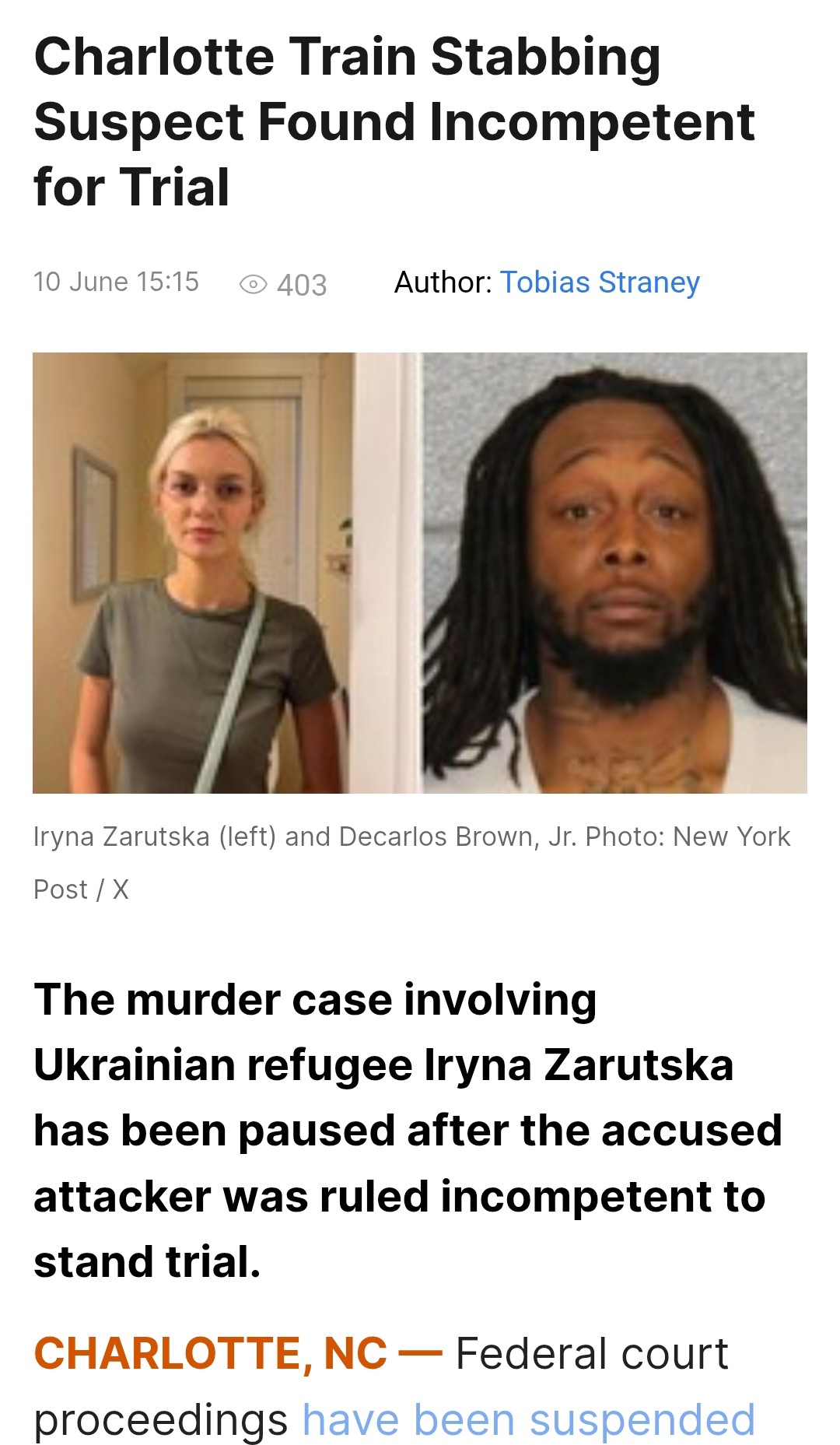
First the state and now Trump's DOJ has found this nigger incompetent to stand trial
He gonna walk.
https://uoj.news/news/87329-charlotte-train-stabbing-s...
He gonna walk.
https://uoj.news/news/87329-charlotte-train-stabbing-s...
- High Skill
- Coding, Godot
- Low Skill
- Drawing, Memes
- Best
- To destroy your enemies, to have them driven before you, and to hear the lamnations of their women.
- Worst
- Python
I draw, code, and make memes sometimes.
Joined Mar 2019