

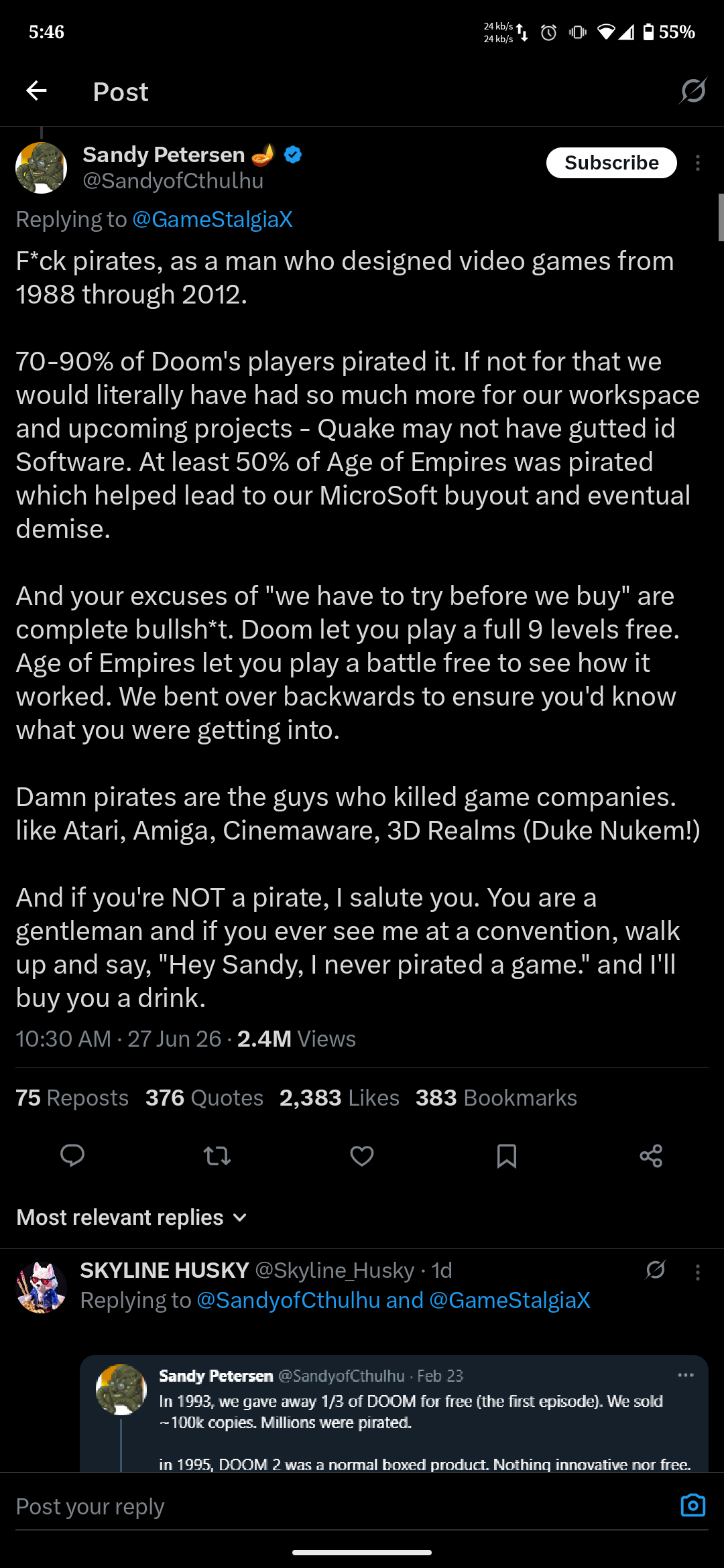
@bonkmaykr Even actual gaming hardware like the Dreamcast didn't die from piracy, at least not directly. If publishers knew (or at least acknowledged) that piracy doesn't kill sales, they would've still supported that hardware. The real problem was that if your console can easily run pirated software, then it can also easily run homebrew and publishers wouldn't have to pay licensing fees to publish their games on your system, and licensing fees are how console manufacturers make money as they sell their systems at a loss. Homebrew is the biggest threat to any console manufacturer (not including "open-source consoles like the Ouya or OpenPandora), not piracy.
>90% of people illegally copying the full version doesn't change that if you're outdoing Windows in install frequency.
And I bet most of those people who pirated the retail version of DOOM were either kids whose parents refused to buy that game for them or people living in countries where the game was outright banned.
@bonkmaykr
>I imagine it wasn't very well thought out because Commodore's main business model was to cut hardware costs, not sell at a loss and live off of software licensing.
That's what also partly killed the TurboGrafx-16 outside of Japan. It seems like the common mistake that computer manufacturers make when trying to enter the console business.
>I don't know much about Atari, I think they tried to improve security after the 2600 but that doesn't exactly work if nobody's buying your machines to begin with.
Atari just never recovered from the video game crash. The 7800 was soft-launched shortly before the NES, but could not compete with it after the NES came to market (games were the exact same ones from the 2600 era, but with better graphics). The Lynx was way too expensive, bulky and ate up batteries. And the Jaguar was a nightmare to program for and whatever advantages it had compared to it's 32-bit or even 16-bit competition was never really shown off during it's lifetime. Piracy didn't kill any of those consoles, but the Atari 2600 was declared an open platform by the courts and that did contribute to their downfall.
Even to this day, they have no idea what they are doing. They thought they could've learned from the mistakes the Ouya made with the VCS, but they didn't realize that PC gaming has become much more accessible over the years (especially when it comes to plugging a PC into the TV) that there really isn't any demand for an "open console" anymore.
Interestingly, the only consoles that Commodore Amiga released, the CDTV and CD32, tried this. It was really half assed though. They had an official licensing system, but anyone with the Amiga developer CD got the CDTV NDK included and could play burned CDs with it. They were just recycled A500 and A1200 computers with a new case and the floppy drive removed. The only thing stopping unlicensed releases was the rights to distribute a copy of the CDTV trademarks, similar to what Game Boy was doing... Which didn't do shit, because threat of litigation only really works on distributors trying to make a notable profit, not an average joe with a good job and a nice CD burner. I imagine it wasn't very well thought out because Commodore's main business model was to cut hardware costs, not sell at a loss and live off of software licensing.
I don't know much about Atari, I think they tried to improve security after the 2600 but that doesn't exactly work if nobody's buying your machines to begin with.
Either way, Sandy doesn't give very good examples.