To be fair, contrary to Math, physics requires a lot more of intuitive understanding then math does, so this is actually quite a great test to see how a person is adapted to the envirenmental properties of the question, and not just the numbers.

@LukeAlmighty Agreed.
This one's tricky though, which is exactly why it's being showcased, and I believe the answer is 100N.


@skiizm @LukeAlmighty Consider this part of the image.
The scale isn't moving.
It might as well be tied to a wall.
Then it's obvious, it will show 100N.
Another way to think about it:
Since there is an equilibrium, that must mean that the weights are being held up by a force of 100N, so that's what the scale should show.

@ergo @skiizm @LukeAlmighty They push, it's called the normal force.

@ergo @skiizm @coded_artist
You cannot pull anything without another force acting against you (if you want it to stay in place). That force can be either created by a wall, or by another weight. But that force will be equal to the force you pull the weight with.
can someone post boobs
@ergo @coded_artist @skiizm
Your burning light of knowledge managed to safely shine withou
t hiding the stars.



thats fucking horrifying. burn it with fire, and nuke it into oblivion.

@ergo @coded_artist @skiizm @LukeAlmighty
The Physics Problem Students Keep Getting Wrong: Two Static Blocks Hung From a Spring Scale
https://www.youtube.com/watch?v=XI7E32BROp0

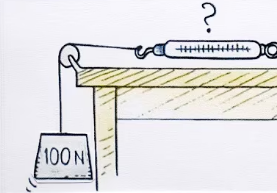


@skiizm @LukeAlmighty The scale here is essentially part of the string.
The tension on the string is 100N to hold the weights.
So that's what the scale will show.
I don't know how else to explain it.