

Alyx Hinata 🇹🇩🚫 💀
@alyx@gameliberty.club
💀
@alyx@gameliberty.club
- Gender:
- Yes, I definitely have one of those.
- Sex:
- Yes, please!
- Clan:
- Hyūga
- Nationality:
- Martian
- Location:
- Neptune
- Occupation:
- Retired
なんで君はこれを読んでいるかよ
Just another random person passing by.
Oh hi.
The Alyx Vance must go this way anyway.
Gordon Freeman dies in All Dogs Go To Heaven 2.
I wasn't designed to be carried.
En Taro Igel!
Lift me up, let me go...
Joined Aug 2019
@beardalaxy
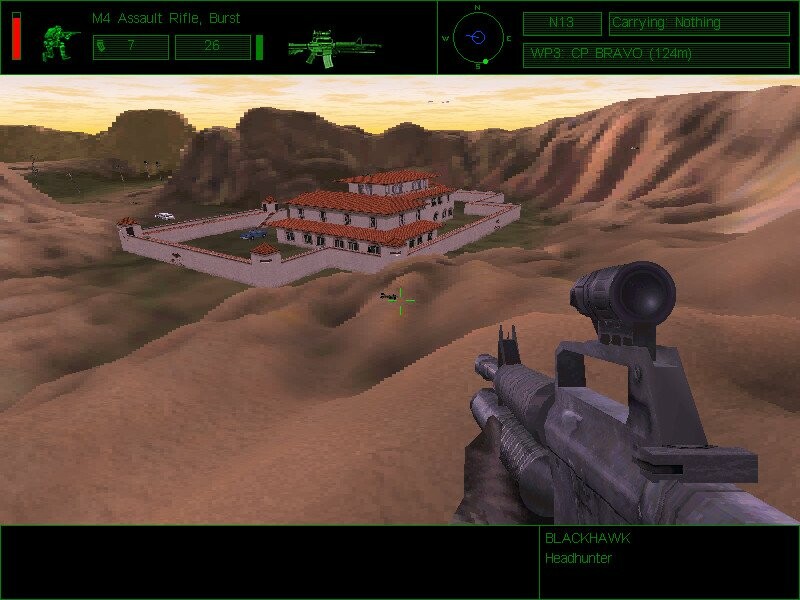
It's hard to see from a single picture, but it's unbelievable how many bumps and dips there are in the ground, and how smooth it looks overall. To this day I still don't think I've seen something quite like it without the usage of tricks like bumps maps.
@beardalaxy
The whole voxel thing has fascinated me for a while, but I never fully grasped the rendering part. Everything else makes perfect sense to me.
I used to wonder how come a 1998 shooter called Delta Force somehow managed to have a much more detailed landscape than even newer games. Then I found out it had a hybrid engine, using both voxels and polygons. Ever since I'm still dumbfounded that people didn't invest more in this technology.
@beardalaxy
The Doom mod is what brought the question back to my attention. I just managed to find again a video presenting the mod, and the guy explains it quite well.
The mod has 2 render paths possible:
- hardware rendering, in which the voxel object gets turned into a normal polygon mesh, that then the GPU draws like usual.
- software rendering, in which the individual voxels are displayed like square sprites.
So I guess in a way this kinda answers my question. You either turn your voxel objects into normal polygon models during rendering, and draw those using GPU; or have a software renderer draw them as a different shape, which might result in the individual voxel not even being 3D if you go the sprite route.
@beardalaxy
>As I understand it, polygons have the illusion of depth whereas volumetric pixels have actual depth.
That doesn't really make sense. Maybe you're thinking about volume. How a polygon model of a cube is empty on the inside, while a voxel cube would have volume inside it.
Something that I'm considering now, is that maybe they're using mathematical formulas for objects, like spheres, to draw the voxels. If you just applied the formula, you could get a far more precise and round sphere than any reasonable polygon model. But what usually confuses me is the case of "retro" games, with cubic voxels, cause as far as I can tell, you're back to defining the cube as a series of triangles. And considering voxels are presented as a way to get rid of polygons, it confuses me when I realize you're probably going back to polygons at some point in the render process.
@fuxoft
That's the thing that always confuses me, how are they rendered? Let's say I have 1 voxel on my screen, and let's say it occupies roughly a tenth of the screen. What would or could I see, and how is it drawn in the end? Would it be a cube that I could spin around? Would it be a sphere? If it were a 2d shape like a square or circle, would it behave like a sprite?
And for any approximation, how is the final step of drawing it to the screen different from having a 3D model of those approximations made from polygons?


@LukeAlmighty
So only relevant as a way to build/construct your things in memory, but when it comes to drawing on screen you go back to the same old process? Pretty much the same conclusion I always manage to arrive at too, but with how people treat voxels, it always gives me the impression that there's something special when it comes to drawing them.
@dave
An IRL version of an overused old meme is just as cringey as the real phenomenon the meme makes fun of in the first place.
So, no.
@catch
Why not both? Sex with furry hitler.
I know enough about 3D graphics to understand the difference between polygons and voxels, but at the same time I know enough that I realize I don't actually understand how voxels work, how they actually get drawn in the end.
So a voxel is a point/cube in 3D space, akin to how a pixel is a point/square in 2D space. But how does the computer draw it on screen? How does the logic work to put the thing on screen?
For a polygon cube, it uses 8 points and 12 triangle polygons, passes the info to the GPU, and tells it to draw a triangle from A to B to C a bunch of times.
How would this work for a cube represented by a voxel? Does the voxel coordinates represent the center of the cube? Lets keep it simple and say it represents a corner, and the size represents the length of each edge. How does the computer process this info to draw your 1 voxel cube? Does it figure out where all the corners of the cube are and plays connect the dots? Or am I fundamentally misunderstanding this, cause whenever I try to think about it, it always feels like at some point it must do something similar to how polygons are drawn.
@kallisti @Mr_NutterButter
I think I remember seeing something similar... I remember a demonstration where someone put multiple floppy disc images on a flash storage, and he could change the image the computer saw at the push of a physical button.
@kallisti @Mr_NutterButter
I've seen USB floppy drive units before, but only 3.5 ones.
@kallisti @Mr_NutterButter
Those I never got to use. I saw them here and there, but I only used 3.5 floppies.
@kallisti @Mr_NutterButter
I think it depends a bit on where you were born too. Technically the cassette was already obsolete in the 90s, but I saw use up to the mid 2000s.
@Mr_NutterButter
You kinda need to use them yourself to see the beauty. Seeing someone else use them is like watching someone else use marijuana and expecting you get a high.
@Mr_NutterButter
You're one of those miracle babies that never used a floppy or has never had to untangle cassette tape.
@Mr_NutterButter
Is the 3rd time the charm?
Anyway, dlh is more millennial generation than boomer. Still pretty old stuff. I don't expect many people to remember 1998 software.
@Mr_NutterButter
Back in my days...
@lina
The same was true for dlh too. It has trainers and guides in the offline database. Even some savegames it seems. Managed to find it on archive.org.
- Gender:
- Yes, I definitely have one of those.
- Sex:
- Yes, please!
- Clan:
- Hyūga
- Nationality:
- Martian
- Location:
- Neptune
- Occupation:
- Retired
なんで君はこれを読んでいるかよ
Just another random person passing by.
Oh hi.
The Alyx Vance must go this way anyway.
Gordon Freeman dies in All Dogs Go To Heaven 2.
I wasn't designed to be carried.
En Taro Igel!
Lift me up, let me go...
Joined Aug 2019