
xianc78 @xianc78@gameliberty.club
- Sex
- Male
- Primary OS
- Linux Mint
- Programming Languages
- C/++/#, Python, Java, JavaScript, PHP, SQL, Assembly
- Personal website
- https://xianc78.codeberg.page/
Joined Jun 2020
xianc78
boosted

Can we ban Windows users from ever commenting on Linux videos? I dont need to hear about you totally wanna switch but muh adobe muh CAD muh GTA online muh valorant muh Ill wait for SteamOS to hit desktop. Annoying thing more annoying then Linux Evangelicals is the nuclear tier cope from Winblows users anytime they are faced with an actually functional OS. Like I get you are still offended over those Mac ads from the Vista and being bullied in middle school for having an android
xianc78
boosted

Youtube just recommended me a very... possibly concerning video.
https://www.youtube.com/watch?v=yh1pF1zaauc
Basically, end to end encryption may be effectively compromised due to AI companion software being able to read whatever's going on on your screen. I highly recommend disabling any AI software that comes pre-packaged with your operating system if this is at all possible. If it's not, then switch to a Linux distribution for your safety.
https://www.youtube.com/watch?v=yh1pF1zaauc
Basically, end to end encryption may be effectively compromised due to AI companion software being able to read whatever's going on on your screen. I highly recommend disabling any AI software that comes pre-packaged with your operating system if this is at all possible. If it's not, then switch to a Linux distribution for your safety.
xianc78
boosted

Windows 10's demise nears, but Linux is forever https://www.theregister.com/2025/01/28/windows_10_demise_linux/ by @sjvn
Want to keep your old computer running? Can't stand #Windows 11? Then, it's time to give serious thought to switching to desktop #Linux.
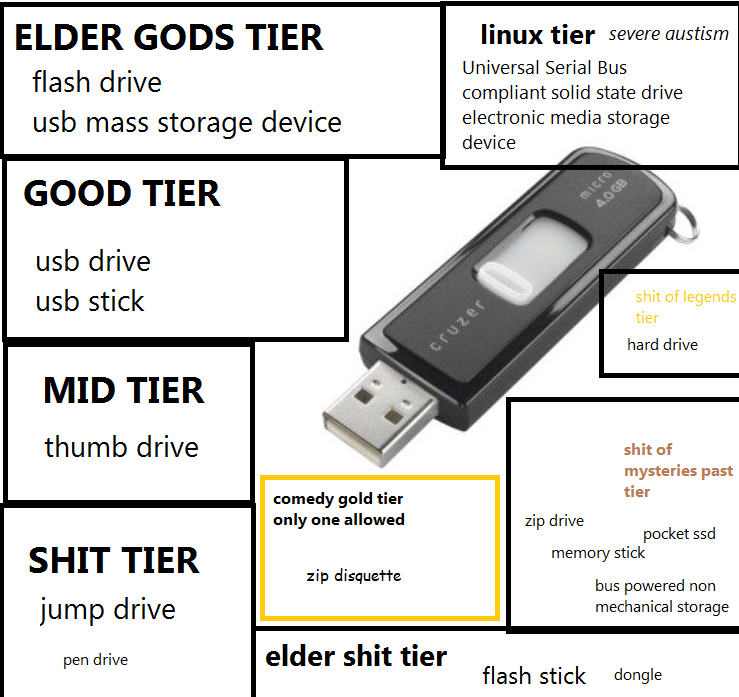
@bonkmaykr Apparently, the different names stem from the fact that many different companies, all of the sudden, came with the idea of having removable flash storage that is accessed by USB and they all had different names for it, some of them being trademark. "Flash Drive" somehow ended up being the dominant name even though the term could technically be used for any flash-memory-based storage.
@souldessin @gabriel I always associate "thumb drive" with those really short flash drives.
xianc78
boosted

What type of series (be it books, movies, or video games) do you prefer? Would you rather have a series that could theoretically go on forever (e.g Mario, Call of Duty, etc) or a series with a definitive end-point (e.g Earthbound/Mother, most book series etc.).
xianc78
boosted

@Alex I agree because you might as well call SSDs "flash drives".
Also it turns out that "jump drive" is trademarked by Lexar which is why the term is rarely used these days.
Nothing says "stuck in the 90s" more than calling flash drives "jump drives".
xianc78
boosted

Exactly. People keep calling this a "Sputnik moment" and that means MORE money will be plowed into US AI, not less. It also means that OpenAI will stop slow-rolling releases and will show us the good stuff now instead of dribbling it out over the next 3 years like they probably originally planned.
xianc78
boosted

@caekislove I bought stonks yesterday because I thought this was a speedbump and that this would spur investment in US AI out of panic.
I did not expect this, but I am now making money either way.
I did not expect this, but I am now making money either way.
xianc78
boosted
They just blocked new registrations to DeepSeek unless you have a Chinese telephone number because they know the benchmarks they published were BS and that DeepSeek hallucinates like a psychotic person. They want you to believe the hype because if you actually use it, it's clearly around 2022 GPT-3 level.
@gabriel Given that it is all running on Meta's servers, I would say no. You could make the case if the software Meta was running was licensed under the AGPL, but the regular GPL doesn't consider network use as distribution.
xianc78
boosted

Does this count as a GPL violation?
(Preventing people from sharing/accessing the source code?)
RE: https://cyberpunk.lol/users/FediPact/statuses/113906932147208715
@wowaname @druid I think a lot of people get individualism wrong. They conflate it with Ayn Rand's Objectivism in which that you should only act within your self-interest (so donating to a charity that doesn't benefit you would be considered morally wrong). In reality very few individualists consider themselves to be Objectivists. Ayn Rand had a lot of great influence on modern libertarianism, but her talking points as is, are considered obsolete.
@vokainen099 Don't do anything stupid and blame me.
@vokainen099 That's what I meant, and I think there are already models like that for GPT4All. Some of them will even give you instructions on making drugs or illegal weapons.
Has anyone forked DeepSeek and removed the pro-CCP biases yet? I want an AI that is completely neutral as possible.
xianc78
boosted



From http://tunes.org/wiki/no-kernel.html
> A term describing a system without a kernel. The idea looks like it is original as far as operating systems are concerned, but it is so natural that for any other kind of software (and one of our points is that there should be no such privileged notion as that of an "Operating System" well-separated from "Applications") where there isn't such a stubbornly overwhelming tradition, it is the very idea of a kernel that looks odd.
> Software in a no-kernel system works just like most any software: various objects interact, each doing its part of the work. The difference compared to software in kernel-based systems? No-kernel software is not limited to a single centralizing entry point like the Unix syscall() or DOS interrupts, whose overhead, limitations, bugs and misdesign you must cope with or work around. Instead, objects can directly interact one with the other, and you can upgrade/extend/modify any unlocked part of the system anytime.

- Sex
- Male
- Primary OS
- Linux Mint
- Programming Languages
- C/++/#, Python, Java, JavaScript, PHP, SQL, Assembly
- Personal website
- https://xianc78.codeberg.page/
Joined Jun 2020