

xianc78 @xianc78@gameliberty.club
- Sex
- Male
- Primary OS
- Linux Mint
- Programming Languages
- C/++/#, Python, Java, JavaScript, PHP, SQL, Assembly
- Ioncom Official Site
- http://ioncom.helioho.st/
Joined Jun 2020
xianc78
boosted

@Terry this is really not going to be a popular opinion but fuck it malfoid is a of psyop and its just as cringe as femoid fiction like morning glory farm
xianc78
boosted

I've added improvements to the navigation, memory and support for landscape mode(yes, it's a button there's no accelerometer on it)
RE: https://akkoma.kumicota.moe/objects/d84929e2-a763-41ee-9a46-73f1578e8c81
RE: https://akkoma.kumicota.moe/objects/d84929e2-a763-41ee-9a46-73f1578e8c81
xianc78
boosted

I don't know what this whole malf*id thing is about or even what it means, but I'm sick and tired of these buzzwords, so I've filtered it.
xianc78
boosted

xianc78
boosted

I'm kind of mixed on these AI mods that basically combine two games in one, even if they were made with separate engines.
On one hand, yes, they are pretty dreamy. The closest we had to this previously were probably Garry's Mod, people importing maps/models into different games, and old games appearing in new games as mini-games that affect said new games. I think all of this would still have happened without AI though. You need to be very familiar with both games you are working with, but advances in decompiling were going on long before AI so it was probably inevitable anyway, but AI is going to churn out these at a faster rate. I had similar ideas of combining games before via emulators emulating two games at once and having the ROMs exchange RAM data between each other, but AI has beaten me to the punch.
But on the other hand, I feel if you can get AI to do this (something that no human has done to my knowledge), then traditional gamedev is out the window. I feel like one of those anti-AI extremists by saying this, but I'm not anti-AI. I've used AI for my last game (generating backgrounds). I only use it as a last resort, but writing an entire game in AI is not my thing. I would never play a game written entirely by AI, even if the design doc was written by a human.
Look at it this way, the indie market is already saturated and this will make it even worse. I know itch.io has the option to filter AI generated content, but like I said, I'm not an anti-AI extremist/ I don't care if you use AI to generate *some* parts of your game, but there are some who have literally called for violence because someone used AI to generate BGM or enhanced the sprites or whatever. We also live in a world where if you accept one idea then you are expected to accept a package of ideas even if they aren't related. These people also want me to share their same opinion on cryptocurrencies and other stuff.
Also, what happens if AI model collapse (when AI starts feeding on it's own data, leading to worse output) does happen? Then all of this would just be lightning in a bottle, unless people are able to make these fusion mods manually.
Though I think the reason why these mods in particular leave a slightly sour taste in my mouth is because most of my game ideas come from combining ideas from my favorite games together and these mods do exactly that. At least my games have original IP so there's that.
xianc78
boosted

in case you didn't know. Every single semi-popular game from the 90s/00s is about to get ported to WASM.
https://openbw.heiner.ai
https://shandalar.dev
https://playxcom.online
https://jka.virtastic.app
https://ja2.virtastic.app
https://morrowind.virtastic.app
https://generals.wasm.ltd
https://openbw.heiner.ai
https://shandalar.dev
https://playxcom.online
https://jka.virtastic.app
https://ja2.virtastic.app
https://morrowind.virtastic.app
https://generals.wasm.ltd
xianc78
boosted

TIL that Burger King asked McDonalds to cooperate on a new sandwich. The "McWhopper" would have been half Big Mac and half Whopper, and would have been released on World Peace Day (September 21) 2015. McDonald's declined the offer.
https://www.tastingtable.com/1570192/what-happened-burger-king-mcwhopper/
#til #todayilearned
https://www.reddit.com/r/todayilearned/comments/1wy5sed/til_that_burger_king_asked_mcdonalds_to_cooperate/
xianc78
boosted

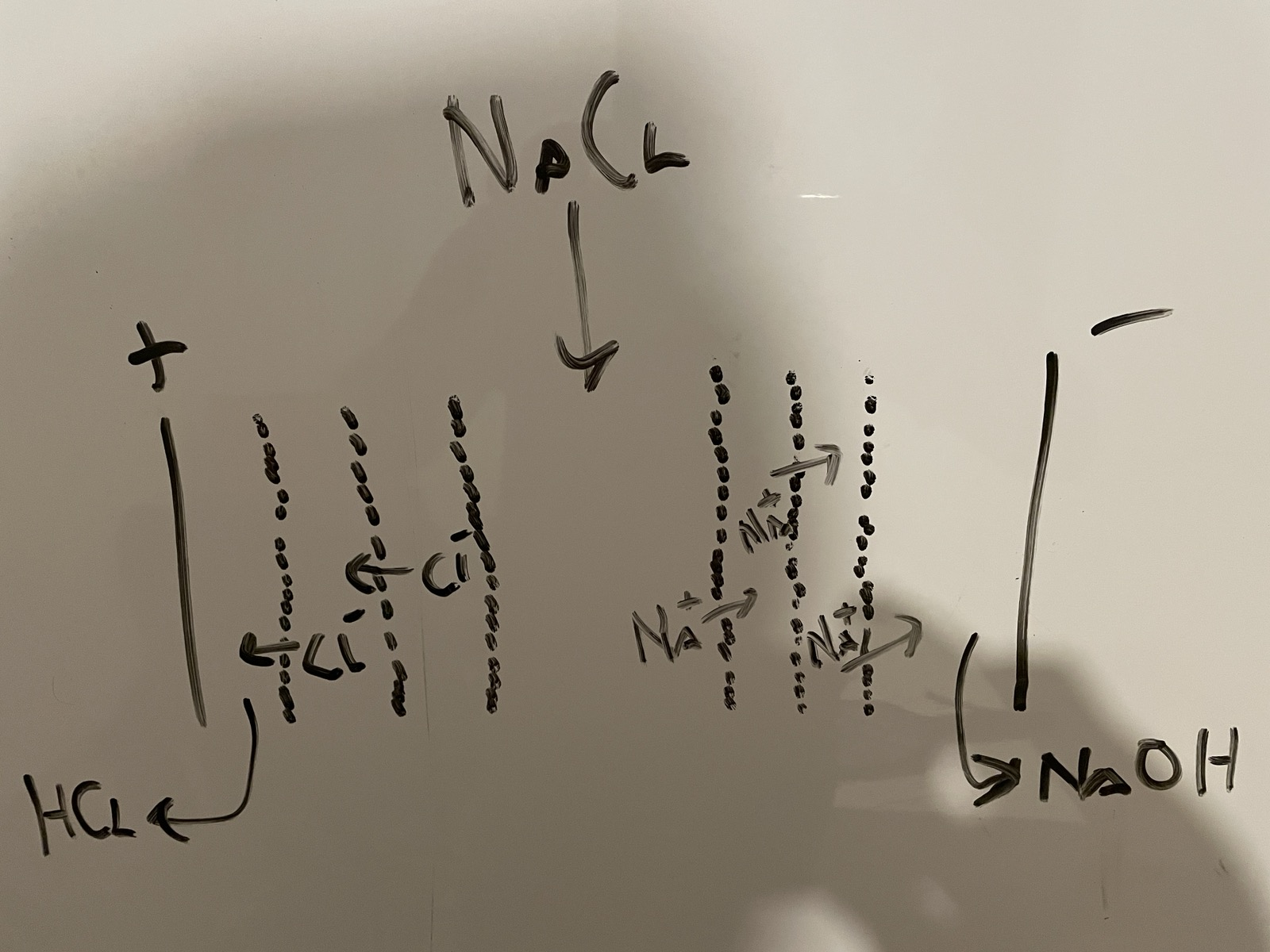
I realize I probably did a shit job of describing that purification cell. So here's a picture (1). Salt goes in the middle, and then there's a stack of cation exchange membranes going toward the left, and a stack of anion exchange membranes going to the right. How to make these is in the YT video in the first post. Cl- heads left and Na+ heads right. At each membrane in the stack, the acidity / alkalinity increases until it eventually reaches the point where it starts either off-gassing HCl or precipitating NaOH, depending on which side you're looking at.
If you don't want the HCl off-gassing, you need to circulate some water into the far left cell to keep the concentration from going too far. As you're adding fresh water, you're removing a little bit of what you're going to store as HCl in water.
If you don't want the HCl off-gassing, you need to circulate some water into the far left cell to keep the concentration from going too far. As you're adding fresh water, you're removing a little bit of what you're going to store as HCl in water.
xianc78
boosted
Sunday Energy Post Is Here!
For people new to this, the premise is always the same: You just spend $10k on solar panels, and because you're not dumb, you bought your panels direct from China and you now have something like 30KW of installed capacity. This means you only need to buy power on a few of the darkest days of the winter, but it also means there's a good 3 months of the summer when your system is cranking out 100kWh per day. What do you do with all of that excess energy? (Ideally, you store it)...
Today we're going to talk about making your own batteries.
Last Sunday's post: https://pkteerium.xyz/@cjd/posts/BAqT8uoMirk4hqxHZw
In case you missed it, a tangental topic: Nobody Understands Leyden Jars: https://pkteerium.xyz/@cjd/posts/BAySnj8t1CerbFWADY
@BigBirdPhoenix requested a tag.
You might wonder why I would suggest making your own battery when companies like CATL and EVE already make them really well and really cheaply. If this was a hobby chemistry post, then a legitimate answer would be "because it's fun". This is not a hobby chemistry post, so we're not talking about doing anything that's already being done more cheaply at a factory.
Commercial batteries absolutely have a role in a home energy storage system for spreading power generation from the sunny part of the day to the night and perhaps bridging over a cloudy day or two. However, commercial batteries cost at least about $50/kWh, so a 100kWh battery costs about $5000 (at the cheapest). We're talking about 90 days of energy in the summer that we need to store, and we're not interested in buying 1/2 million dollars worth of commercial batteries.
> What makes you think you can beat what's commercially available?
We have different requirements.
1. Commercial battery cells must be self-contained with no user-serviceable parts. Nobody wants a battery they might have to open up and clean once a year. For our needs, some amount of greasing, oiling, cleaning, and inspecting is not unreasonable.
2. Commercial batteries are usually designed with EVs in mind so they are expected to charge really quickly. If we have a battery for storing 90 days of summer energy, it's okay if it takes 90 days to charge.
3. A commercial battery cell must not require on-site assembly. We're assembling the cell already, so this restriction has zero value to us.
4. Commercial batteries need to have (at least) good enough energy per weight that they're worth shipping over from China. As they're typically designed for EVs or other portable applications, the energy density expectation is usually far higher than that. We care far more about the up-front cost per kWh than the weight.
5. Commercial batteries typically have a round-trip efficiency in the 90+% range. A battery chemistry that loses 20% of its energy charging and discharging might be dismissed as commercially infeasible, but when we compare it with pumped hydro at 70% efficiency, and various hydrogen storage models with 10-50% efficiency, we see that fairly lossy batteries can still be quite practical.
On our side, we have three requirements that commercial battery companies don't have:
1. We need our battery components to be *readily available*. Something like LiPF₆ electrolyte salt might be "cheap" if you buy it by the train car load, but you won't find it at the corner store, and buying it in small quantities might lead you to lab supply companies with very high markups.
2. We need a chemistry which is tolerant of some contamination. We don't have a factory where we can exclude water and oxygen down to parts-per-million levels, so we'd rather avoid chemicals that react with them rather than having to build one.
3. We'd like our chemistry to be more or less human friendly and realistic to dispose of. We can be expected to act like adults and use PPE, but it would be nice not to have mustard gas coming out of our cell when we open it for inspection. Moreover, if we have 100 tons of acid, we would like to have a plan to neutralize it rather than just: Truck it all to a toxic waste disposal company at massive expense, or dumping it in the storm gutter which is a crime and is gonna leave a LOT of evidence when it kills absolutely everything.
---
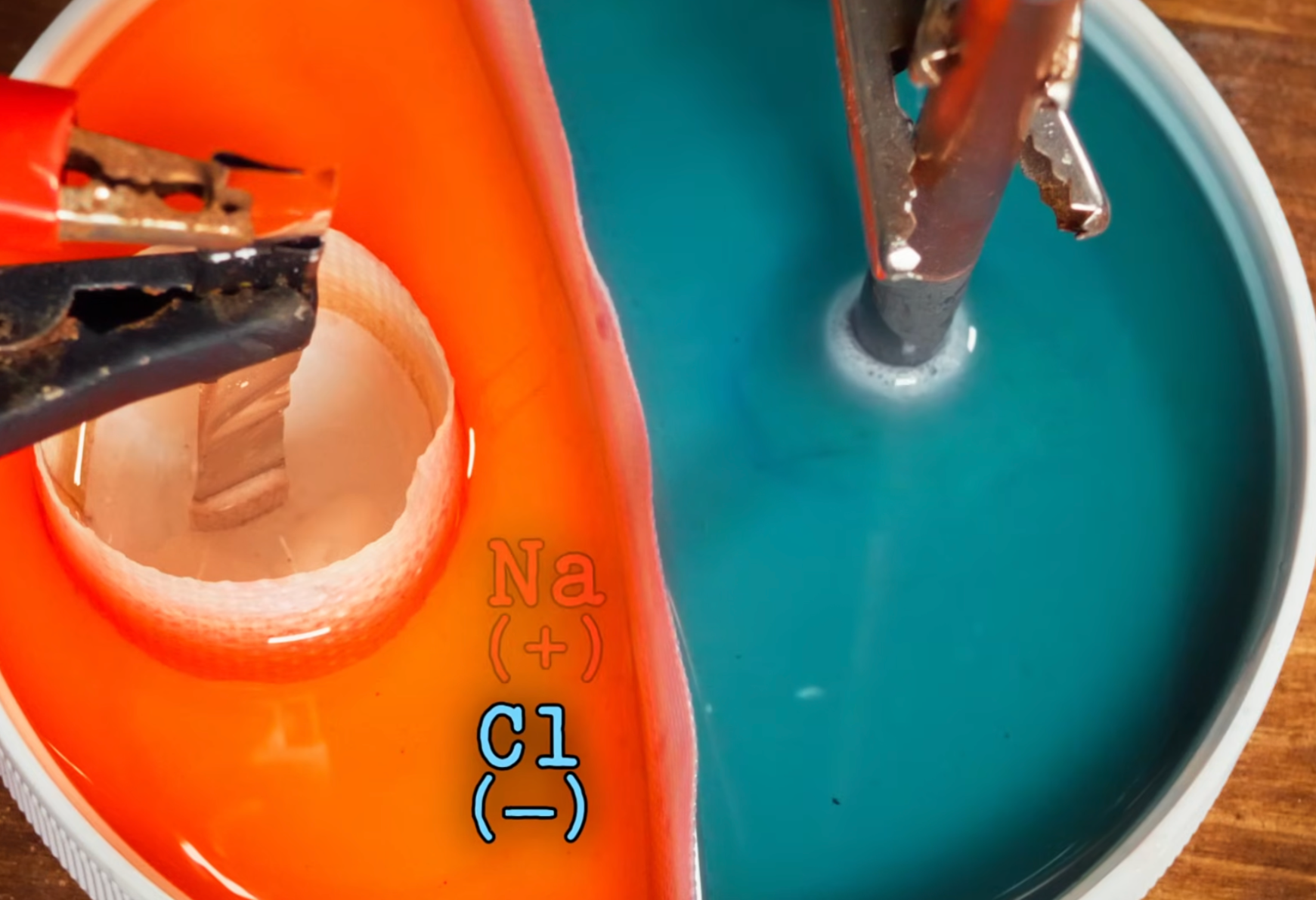
The simplest kind of battery is basically an electrolysis cell. You put salt water in a cell with anode, cathode and ion exchange membrane, the salt splits into NaOH and HCl. Discharging it turns the NaOH and HCl back into salt. You can store about 0.1 kWh per kilogram of salt this way. Your salt concentrations should be somewhere between 1% and 11%, so lets say you are able to convert 1kg of salt per 10kg of water. Figure 1, from this fabulous YT: https://www.youtube.com/watch?v=eq7fR9ISuCw (but note this is not the iron battery he describes)
This is obviously challenged in terms of energy density. You're looking at 10kwh per ton (cubic meter) of water. But just because you're limited to 10% salt in water doesn't mean you're required to keep that water indefinitely.
The same chemistry works in acid or alkaline as it does in neutral PH, so after you've finished making your salt into HCl and NaOH, you can then take each component and electrolyze them in isolation, turning even more salt into even more HCl and NaOH.
It turns out that you don't need to pump the electrolyte from one cell to another, all you need to do is add more ion exchange membranes, and you raise the voltage since now it is a series cell stack. The same rules apply - one side becomes acid and the other side becomes base, it's just that they become far more acid and base than they would.
Now that brings us to our extremes:
At 37% HCl in water, the HCl begins leaving as a gas.
At 50% NaOH, the NaOH begins settling out as a solid.
There are two storage choices, either store enriched water, or store solids. 1kg of NaCl makes 0.684kg of NaOH and 0.624kg of HCl.
If we choose to store 33% HCl in water rather than letting it get to 37% and offgas, we can store our 0.624kg of HCl in 1.63L.
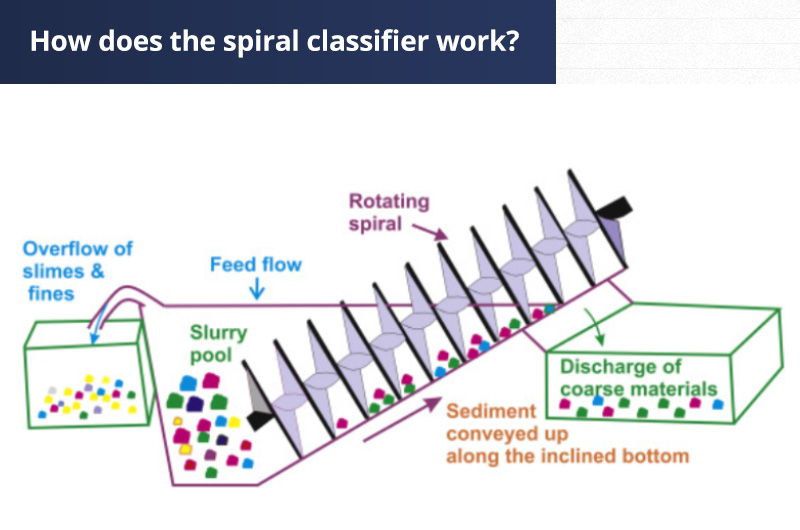
On the NaOH side, we'd be better off driving it to crystalize out and then using settling ponds and spiral classifier to get it out of the liquid and store it in a semi-dry storage. It's more mechanical hardware, but the resulting material to store is a solid which is much safer. Our 0.684kg of NaOH comes out to 0.32L of solid material.
So this way, 1kg of salt turns into 1.63 liters of liquid, giving us 100 watt-hours of storage. 1 tonne of salt into 1.63 cubic meters of acid plus 0.32 cubic meters of lye gives us 100 kWh of storage.
This is "okay" but not great, because we're tying up a lot of acid and if it spills, that's a serious environmental disaster. It's kind of obligatory to put the acid in a double-walled container with water on the outside so that if the inner wall fails, water goes in rather than acid coming out. But 163 cubic meters is "a couple swimming pools" and would store 10,000 kWh - or 500mn$ worth of batteries.
Batteries are a massive area of research so there's a lot of other stuff I can write. Eliminating the storage of large amounts acid is possible by playing with the chemistry - and I may or may not continue in a part 2...
For people new to this, the premise is always the same: You just spend $10k on solar panels, and because you're not dumb, you bought your panels direct from China and you now have something like 30KW of installed capacity. This means you only need to buy power on a few of the darkest days of the winter, but it also means there's a good 3 months of the summer when your system is cranking out 100kWh per day. What do you do with all of that excess energy? (Ideally, you store it)...
Today we're going to talk about making your own batteries.
Last Sunday's post: https://pkteerium.xyz/@cjd/posts/BAqT8uoMirk4hqxHZw
In case you missed it, a tangental topic: Nobody Understands Leyden Jars: https://pkteerium.xyz/@cjd/posts/BAySnj8t1CerbFWADY
@BigBirdPhoenix requested a tag.
You might wonder why I would suggest making your own battery when companies like CATL and EVE already make them really well and really cheaply. If this was a hobby chemistry post, then a legitimate answer would be "because it's fun". This is not a hobby chemistry post, so we're not talking about doing anything that's already being done more cheaply at a factory.
Commercial batteries absolutely have a role in a home energy storage system for spreading power generation from the sunny part of the day to the night and perhaps bridging over a cloudy day or two. However, commercial batteries cost at least about $50/kWh, so a 100kWh battery costs about $5000 (at the cheapest). We're talking about 90 days of energy in the summer that we need to store, and we're not interested in buying 1/2 million dollars worth of commercial batteries.
> What makes you think you can beat what's commercially available?
We have different requirements.
1. Commercial battery cells must be self-contained with no user-serviceable parts. Nobody wants a battery they might have to open up and clean once a year. For our needs, some amount of greasing, oiling, cleaning, and inspecting is not unreasonable.
2. Commercial batteries are usually designed with EVs in mind so they are expected to charge really quickly. If we have a battery for storing 90 days of summer energy, it's okay if it takes 90 days to charge.
3. A commercial battery cell must not require on-site assembly. We're assembling the cell already, so this restriction has zero value to us.
4. Commercial batteries need to have (at least) good enough energy per weight that they're worth shipping over from China. As they're typically designed for EVs or other portable applications, the energy density expectation is usually far higher than that. We care far more about the up-front cost per kWh than the weight.
5. Commercial batteries typically have a round-trip efficiency in the 90+% range. A battery chemistry that loses 20% of its energy charging and discharging might be dismissed as commercially infeasible, but when we compare it with pumped hydro at 70% efficiency, and various hydrogen storage models with 10-50% efficiency, we see that fairly lossy batteries can still be quite practical.
On our side, we have three requirements that commercial battery companies don't have:
1. We need our battery components to be *readily available*. Something like LiPF₆ electrolyte salt might be "cheap" if you buy it by the train car load, but you won't find it at the corner store, and buying it in small quantities might lead you to lab supply companies with very high markups.
2. We need a chemistry which is tolerant of some contamination. We don't have a factory where we can exclude water and oxygen down to parts-per-million levels, so we'd rather avoid chemicals that react with them rather than having to build one.
3. We'd like our chemistry to be more or less human friendly and realistic to dispose of. We can be expected to act like adults and use PPE, but it would be nice not to have mustard gas coming out of our cell when we open it for inspection. Moreover, if we have 100 tons of acid, we would like to have a plan to neutralize it rather than just: Truck it all to a toxic waste disposal company at massive expense, or dumping it in the storm gutter which is a crime and is gonna leave a LOT of evidence when it kills absolutely everything.
---
The simplest kind of battery is basically an electrolysis cell. You put salt water in a cell with anode, cathode and ion exchange membrane, the salt splits into NaOH and HCl. Discharging it turns the NaOH and HCl back into salt. You can store about 0.1 kWh per kilogram of salt this way. Your salt concentrations should be somewhere between 1% and 11%, so lets say you are able to convert 1kg of salt per 10kg of water. Figure 1, from this fabulous YT: https://www.youtube.com/watch?v=eq7fR9ISuCw (but note this is not the iron battery he describes)
This is obviously challenged in terms of energy density. You're looking at 10kwh per ton (cubic meter) of water. But just because you're limited to 10% salt in water doesn't mean you're required to keep that water indefinitely.
The same chemistry works in acid or alkaline as it does in neutral PH, so after you've finished making your salt into HCl and NaOH, you can then take each component and electrolyze them in isolation, turning even more salt into even more HCl and NaOH.
It turns out that you don't need to pump the electrolyte from one cell to another, all you need to do is add more ion exchange membranes, and you raise the voltage since now it is a series cell stack. The same rules apply - one side becomes acid and the other side becomes base, it's just that they become far more acid and base than they would.
Now that brings us to our extremes:
At 37% HCl in water, the HCl begins leaving as a gas.
At 50% NaOH, the NaOH begins settling out as a solid.
There are two storage choices, either store enriched water, or store solids. 1kg of NaCl makes 0.684kg of NaOH and 0.624kg of HCl.
If we choose to store 33% HCl in water rather than letting it get to 37% and offgas, we can store our 0.624kg of HCl in 1.63L.
On the NaOH side, we'd be better off driving it to crystalize out and then using settling ponds and spiral classifier to get it out of the liquid and store it in a semi-dry storage. It's more mechanical hardware, but the resulting material to store is a solid which is much safer. Our 0.684kg of NaOH comes out to 0.32L of solid material.
So this way, 1kg of salt turns into 1.63 liters of liquid, giving us 100 watt-hours of storage. 1 tonne of salt into 1.63 cubic meters of acid plus 0.32 cubic meters of lye gives us 100 kWh of storage.
This is "okay" but not great, because we're tying up a lot of acid and if it spills, that's a serious environmental disaster. It's kind of obligatory to put the acid in a double-walled container with water on the outside so that if the inner wall fails, water goes in rather than acid coming out. But 163 cubic meters is "a couple swimming pools" and would store 10,000 kWh - or 500mn$ worth of batteries.
Batteries are a massive area of research so there's a lot of other stuff I can write. Eliminating the storage of large amounts acid is possible by playing with the chemistry - and I may or may not continue in a part 2...
xianc78
boosted

DIRE EMERGENCY, PLEASE BOOST
I need help finding a meme.
Back during lockdown there was this hilarious tiktok/reel of a young woman playing disturbia while being flustered by the Quaker Oats man.
xianc78
boosted

reddit is killing rss? fucking god damn it. and i thought it was bad enough you need a login for old ui now and the new one on mobile user agent fucking loginwalls you after like 10 fucking seconds of free viewing insisting on using an app. so what not even accounts can have rss now? thats so gay. might need to write a scraper for this
These stories about AI breaking containment are just another psyop.
Remember back when Klaus Schwab warned about a "cyber pandemic"? This might be part of the script. Instead of China, Russia, North Korea, or some rogue organization creating a massive cyber-attack, AI will be the culprit. But there will be no attack. One or more of these major infrastructure services will voluntarily go down and claim that they have been hacked. That's probably why AI development supposedly surged after the pandemic. It's not a coincidence.
Don't fall for it.
xianc78
boosted

Alright, for my birthday I went to EBGames and got a few games.
I wanted to possibly get:
-Trails in the Sky Chapter 2 Switch 2 Edition
-Metroid Prime 4 Switch 2 Edition
-Splatoon Raiders
-Yoshi and the Mysterious Book
-Fire Emblem: Fortune’s Weave
-Maaaybe Star Fox
Because video games stores fails to be a fucking store lately, I only got MP4 and Yoshi. For Trail Chap 2 I'll wait until I have finished Chap 1
I wanted to possibly get:
-Trails in the Sky Chapter 2 Switch 2 Edition
-Metroid Prime 4 Switch 2 Edition
-Splatoon Raiders
-Yoshi and the Mysterious Book
-Fire Emblem: Fortune’s Weave
-Maaaybe Star Fox
Because video games stores fails to be a fucking store lately, I only got MP4 and Yoshi. For Trail Chap 2 I'll wait until I have finished Chap 1
xianc78
boosted

theres a pc98 demo dropping at deadline 2026 be sure to tune in this shit is gonna be fire
xianc78
boosted

xianc78
boosted
1. Governments deploying mass surveillance to detect potential terrorists
2. Fed-posting becoming a cultural phenomenon
2. Fed-posting becoming a cultural phenomenon
xianc78
boosted
Update, I'm now the proud owner of a French patent application number.
Now I'm dreading the examiner is going to take me on a brief but damning tour of the fifteen billion times this has been done already that somehow I never heard of. Pic related.
But for now (and for the next year or so) it's just gonna be radio silence...
RT: https://pkteerium.xyz/objects/55034cae-5c4a-4de1-96ca-81e47fdc1e63
Now I'm dreading the examiner is going to take me on a brief but damning tour of the fifteen billion times this has been done already that somehow I never heard of. Pic related.
But for now (and for the next year or so) it's just gonna be radio silence...
RT: https://pkteerium.xyz/objects/55034cae-5c4a-4de1-96ca-81e47fdc1e63
xianc78
boosted





- Sex
- Male
- Primary OS
- Linux Mint
- Programming Languages
- C/++/#, Python, Java, JavaScript, PHP, SQL, Assembly
- Ioncom Official Site
- http://ioncom.helioho.st/
Joined Jun 2020